
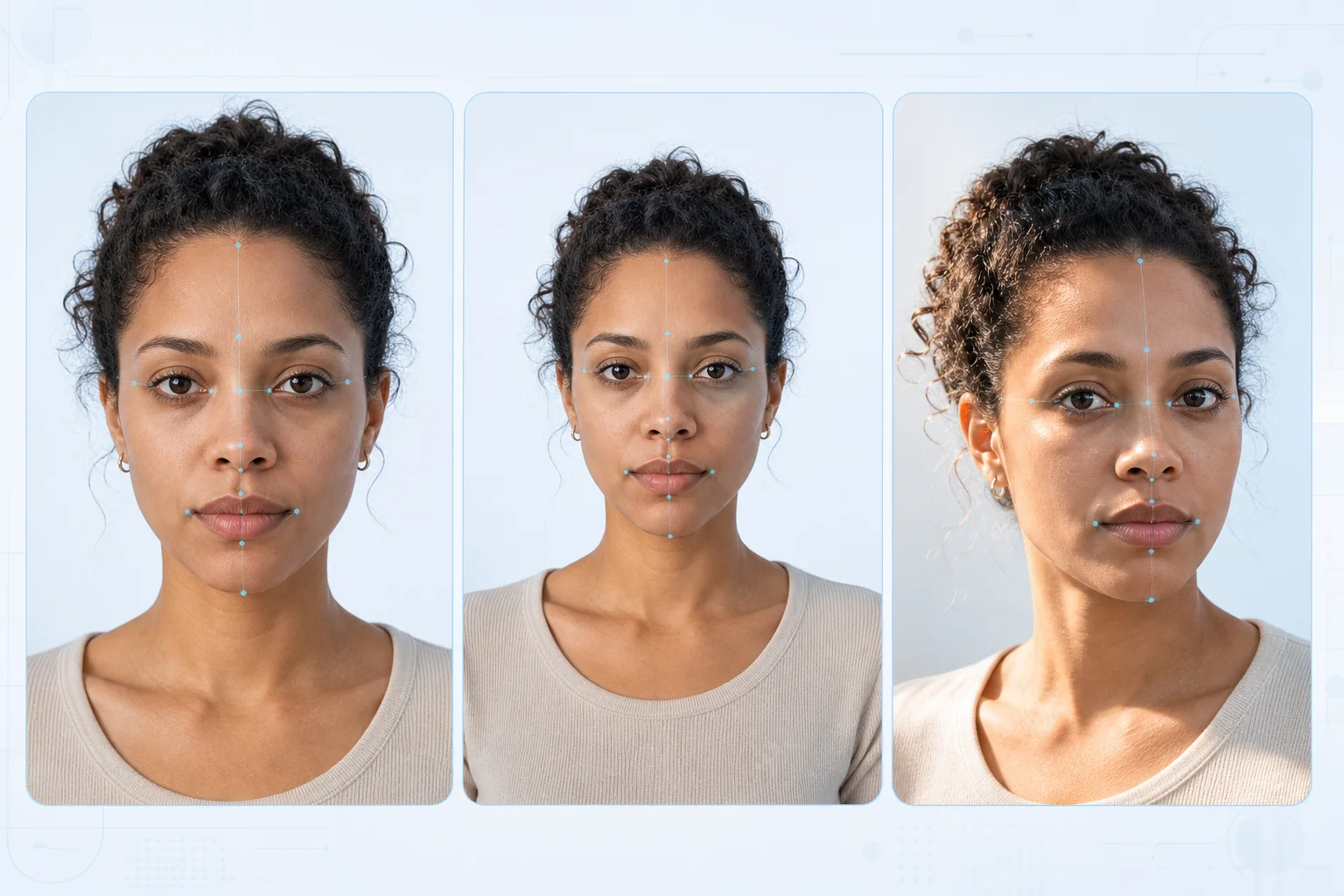
Two photos of the same person can receive different AI face scores, and the same file can produce different results in two apps. AI analyzes the current image and the landmarks, proportions, contours, and confidence derived from it. It does not read a fixed identity score independent of the photo and algorithm.
The short answer
AI face scores usually change because camera distance, head pose, expression, lighting, image quality, occlusion, filters, or the app’s scoring method changed. A different result first tells you that the image input or calculation rules differ; it does not prove that the person’s face changed.
| Observed change | Common cause | Check first |
|---|---|---|
| Nose or midface changes size | Distance and perspective | Was the phone too close? |
| One side looks lower or narrower | Yaw, roll, camera offset | Are eyes level and ears similarly visible? |
| Symmetry score changes | Pose, expression, side shadow | Was the photo frontal and evenly lit? |
| Landmarks jump | Blur, compression, occlusion | Is the original image clear? |
| Apps disagree | Different models, metrics, weights, scales | Compare methods, not raw scores |
What does an AI face score analyze?
- Detect a usable face.
- Locate eye, brow, nose, mouth, chin, and contour landmarks.
- Estimate pose and photo quality.
- Calculate distances, angles, symmetry, or shape from 2D coordinates.
- Compare measurements with the tool’s reference ranges.
- Apply weights to form categories or a total score.
- Return an explanation, confidence, or feedback.
Any change in this pipeline can change the number. Decimal precision is not useful when the input or landmarks are wrong.
Why does the same person not mean the same input?
A face is three-dimensional; a photo is a two-dimensional projection created from one lens position, pose, and lighting setup. In seconds, the phone can move, head angle and expression can shift, automatic exposure can change, and one file may be mirrored or processed differently. The person may be unchanged while visible landmark distances are not.
1. Camera distance and perspective
At close range, the nose and central face are nearer the lens than the cheeks and ears, so they appear relatively larger. Nose-to-face width, eye spacing, contour, side balance, and ratio calculations can change. Perspective depends mainly on actual camera distance, not only the displayed lens label. Step back, use a normal field of view, and crop moderately.
2. Turning left or right: yaw
A slight left-right turn makes the farther side look narrower. One eye may look smaller, the nose tip may shift, one facial edge moves inward, and left-right correspondence changes. Similar visibility of both ears is a practical check for a nearly frontal pose.
3. Looking up or down: pitch
A high camera or lowered head changes the projection of the forehead, nose base, chin, and jaw. A low camera or raised head emphasizes the nose base and lower face. Facial thirds, lower-face length, jaw contour, and face-shape classification may all change. Move the camera to eye level instead of moving the chin toward it.
4. Head tilt: roll
Tilting toward a shoulder makes the eye line, brows, nostrils, and mouth corners slope. Rotating the final image can level the eyes but cannot remove every three-dimensional projection change, especially when tilt and yaw occur together.
5. Expression and jaw state
Smiling can widen the mouth, raise the corners, narrow the eyes, lift the cheeks, and change the jaw contour. Pursing or opening the lips, clenching, projecting the chin, raising the brows, and squinting also move landmarks. A smile photo is analyzable, but it is not the same input as a neutral photo. Use a relaxed, repeatable expression for static comparisons.
6. Lighting and shadow direction
Light does not move bone, but it changes the edges and textures the system can see. Strong side light may erase a bright-side boundary and hide a dark-side eye corner, nostril, or jaw. Top light deepens eye and nose shadows; backlight can underexpose the whole face. Soft, even frontal or front-side light is easier to measure.
7. Blur, noise, resolution, and compression
Motion blur, missed focus, low-light noise, and repeated compression make eye corners, lip corners, nostrils, and the chin edge uncertain. Video frames, messaging previews, screenshots, and heavily sharpened files are common causes. If the original lacks detail, AI enhancement may invent boundaries; retaking the photo is more reliable.
8. Hair, glasses, crop, and occlusion
Bangs can cover eyes or brows, side hair can replace the true facial edge, glare can hide the eyes, and hands, masks, scarves, tight crops, or portrait blur can remove the lower face and hairline. Different occlusion between photos produces different landmark estimates. Keep important regions similarly visible.
9. Filters, beauty effects, and computational photography
Face slimming, eye enlargement, nose narrowing, chin reshaping, automatic asymmetry correction, virtual makeup, and strong smoothing change either geometry or visible boundaries. Native phone processing such as HDR, sharpening, denoising, and lens correction may also differ by mode. A geometrically reshaped image produces a score for the edited image.
10. Different apps use different models and scales
Apps may use different landmark models, measurement sets, reference samples, weights, missing-point rules, formulas, prompts, and score ranges. One may emphasize symmetry while another emphasizes ratios or face shape. A score of 78 in one app is not automatically equivalent to 7.8 in another.
Is there one true AI face score?
No single objective score works across all tools, photos, and cultural contexts. Every total depends on what features were selected, how landmarks were defined, what reference range was chosen, how weights were assigned, and how photo quality was handled.
AI can apply one rule consistently, but consistency does not turn that rule into a universal law of attractiveness. Measurements, overlays, category evidence, and confidence are more interpretable than a context-free total.
How to tell whether the photo or method caused the change
Same app, different photos
Check distance, yaw, pitch, roll, expression, lighting, clarity, occlusion, filters, mirroring, and crop. Differences mainly show input variation and model sensitivity.
Same photo, different apps
When the exact original file is controlled, differences mainly come from models, metrics, weights, references, and score conversion. Compare what each tool measures, whether it shows landmarks and photo quality, and whether it offers categories rather than only a total.
Does a changing result mean the model is broken?
Not necessarily. Different inputs should sometimes produce different measurements. Warning signs include large random changes for the identical file, visibly misplaced landmarks paired with high confidence, contradictory explanations for unchanged categories, no photo-quality disclosure, and negative judgments based on poor input.
Stability and validity are different. Repeating the same number shows consistency, not proof that the tool measures a universal concept.
When should you ignore the result?
- Low-confidence warning.
- Strong yaw, pitch, or roll.
- Obvious close-range distortion.
- Eyes, nose, mouth, chin, or outline hidden.
- Blurred, pixelated, or heavily compressed image.
- Strong beauty or reshaping filter.
- Landmarks visibly misplaced.
- Multiple people with an unclear target.
- No explanation of what the score means.
Low-quality input is not evidence of a low-quality face; it only means the image cannot support a reliable analysis.
How to standardize a retest
- Use the same phone and lens.
- Mark the camera and subject positions.
- Keep the camera near eye level.
- Face forward without tilt.
- Use the same relaxed expression.
- Keep soft, even light consistent.
- Expose eyes, brows, nose, mouth, chin, and outline.
- Turn off beauty, filters, and reshaping.
- Use a clear original file.
- Keep mirroring and crop consistent.
Save one acceptable setup as a reference. The AI face-analysis photo guide provides a full checklist.
What should you compare?
- Photo quality: pose, clarity, light, and occlusion.
- Landmarks: whether eye, nose, mouth, chin, and contour points are correct.
- Confidence: which categories are reliable.
- Categories: specific thirds, fifths, symmetry, and contour relationships.
- Image evidence: whether overlays support the text.
- Method: whether metrics, weights, and reference ranges match.
- Total score: only a limited comparison under the same method and similar input.
Read facial harmony versus symmetry to understand why symmetry is only one part of the picture.
Why you should not chase the highest score
With enough changes in angle, light, expression, and filters, you can find a photo that better fits almost any algorithm. The highest score usually shows which image best matches that tool’s preferred input and rules, not a verified personal truth. Standardize one useful photo and understand the evidence instead.
What AI face scores can and cannot tell you
With a suitable photo and transparent method, an analysis can describe selected proportions, visible left-right correspondence, vertical and horizontal regions, relative positions under one reference, and photo-quality limitations.
One photo cannot prove universal attractiveness, health, personality, intelligence, morality, identity attributes, treatment need, or social value. The score describes a relationship between an image and a method, not a judgment of a person.
Frequently asked questions
Why do two photos taken on the same day score differently?
Distance, pose, expression, light, and automatic camera processing can change within seconds.
Can the exact same file change when retested?
A deterministic calculation should usually stay consistent. Large unexplained random changes deserve caution.
Do front and rear cameras give different results?
They can because lens, distance, mirroring, beauty processing, detail, and computational photography differ.
Why do AI apps disagree so much?
They may use different landmarks, metrics, reference samples, weights, and score ranges.
Which score is real?
There is no single score shared by all tools. Each belongs to one photo and one calculation method.
Can lighting change a geometry score?
Light changes visible edges and landmark placement, so it can indirectly change image measurements.
Do beauty filters affect scores?
Yes, especially face slimming and eye, nose, or chin reshaping.
Can score changes prove treatment or training worked?
No. Consumer photo scores alone cannot prove health or treatment effects.
Treat score changes as an input and method problem first
AI face scores change at three levels: the photo input changes, landmark measurements change, or the scoring method changes. Standardize camera, distance, height, pose, expression, light, occlusion, and processing; check photo quality and landmarks before categories, and view the total last.
Continue with facial fifths and eye spacing and what facial harmony means, or analyze a standardized front-facing photo with FacialHarmonyAI. This article is educational and is not medical, psychological, or cosmetic advice.