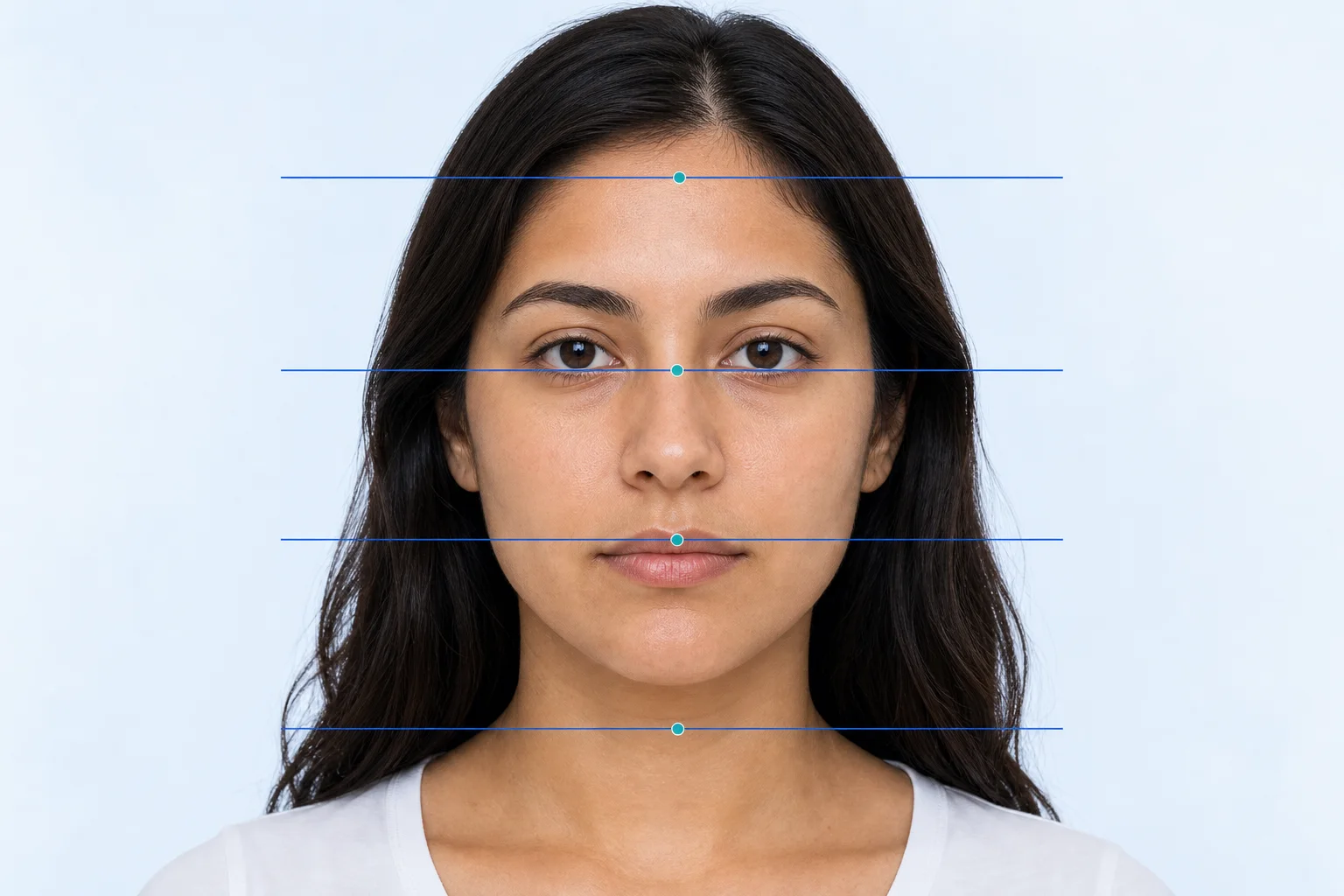
How modern research is redefining beauty standards—and why understanding your individual proportions is the key to authentic confidence.
Rethinking Beauty: Beyond Universal Standards
For centuries, we've been told that beauty follows a universal formula. The golden ratio. Perfect symmetry. Specific proportions that supposedly define attractiveness across all cultures and all faces.
But recent research is challenging this assumption. A landmark study published in Medicina (2025) reveals something fascinating: there is no single, universal prototype of a beautiful face. Instead, beauty lies in the overall harmony and integration of facial features—and this harmony is deeply personal, culturally influenced, and beautifully unique.
This shift in understanding has profound implications for how we think about facial aesthetics, cosmetic interventions, and—most importantly—how we perceive ourselves.
The New Science of Facial Harmony
What Researchers Discovered
A team of anatomists from Bursa Uludag University and Harran University in Turkey conducted a rigorous study with 100 volunteers (50 male, 50 female), measuring 40 distinct parameters across four facial regions:
- Face: 8 measurements including facial height, width, and proportions
- Eyes: 12 measurements covering spacing, lid position, and iris dimensions
- Nose: 8 measurements from root width to tip projection
- Lips: 12 measurements capturing philtrum, vermilion, and mouth dimensions
Their goal wasn't to find a "perfect" face. Instead, they sought to develop personalized regression equations—mathematical tools that could predict optimal morphometric features for each individual based on their unique facial structure, gender, and cultural background.
The Key Finding: Harmony Over Perfection
The study's most important conclusion? There is no unique and identifiable prototype of a beautiful face. The attractiveness of a face lies in its overall harmony and integration with the rest of the face—not in any single feature meeting some universal standard.
This means:
- A "perfect" nose doesn't make a face beautiful if it doesn't complement the chin, eyes, and overall facial structure
- Beauty standards vary significantly across cultures and ethnic groups
- The most aesthetically pleasing results come from enhancing what's already there, not from imposing external ideals
- Individual characteristics—including those that deviate from "average"—can contribute to exceptional beauty when they're in harmony with surrounding features
The Role of Proportion and Balance
The research reinforces what artists and philosophers have known for millennia: proportion is the backbone of facial aesthetics. The ancient Greeks believed that beauty resulted from "a certain order, harmony, measure, and proportion between the elements"—and modern science confirms this intuition.
But here's the critical nuance: proportion isn't about hitting specific numbers. It's about relationships. A harmonious face is one where:
- Features relate to each other in balanced, coherent ways
- No single element appears disproportionately salient
- The overall configuration is easy and pleasant for observers to process
- Individual characteristics are integrated rather than competing
Why Personalization Matters More Than Ever
The Problem with One-Size-Fits-All Approaches
Traditional approaches to facial aesthetics often relied on universal standards—the golden ratio, neoclassical canons, or population averages. While these provide useful reference points, they have significant limitations:
Cultural Variation: What's considered beautiful in one culture may differ dramatically in another. The study emphasizes that beauty standards are anchored in local population norms, not universal ideals.
Individual Uniqueness: Each face is a complex system of interrelated features. A change that improves one area might disrupt harmony in another if it doesn't account for the individual's overall structure.
Dynamic Relationships: Facial features don't exist in isolation. The nose relates to the chin, which relates to the midface, which relates to the eyes. Altering one element affects the perception of all others.
The Promise of Personalized Analysis
This is where modern AI-powered facial analysis becomes transformative. Rather than measuring faces against universal templates, advanced tools can:
- Detect individual landmarks: Identify the unique positions and proportions of your specific features
- Calculate relationships: Analyze how your features relate to each other within your facial structure
- Assess harmony: Evaluate whether features are in balanced proportion relative to each other—not to some external ideal
- Provide context: Explain what specific proportions mean for your overall presentation
The researchers themselves noted that their work could "inspire software or artificial intelligence applications related to facial or facial organ design"—exactly the kind of technology that's now becoming available to consumers.
How AI Analysis Bridges Research and Reality
From Lab to Life
The Babacan and Deniz study measured 40 parameters using specialized software and trained researchers. Today's AI facial analysis tools bring similar capabilities directly to consumers:
Consistency: AI applies the same rigorous measurement criteria to every analysis, eliminating the subjective variation that can affect human assessment.
Comprehensive Evaluation: Rather than focusing on isolated features, AI evaluates the relationships between multiple facial regions simultaneously—exactly the holistic approach the research recommends.
Accessibility: What once required professional consultation and specialized equipment can now begin with a single photograph and a few minutes of analysis.
Privacy-First Design: Modern platforms perform analysis directly in your browser, store only structured data (not raw photos unless you opt in), and give you full control over deletion.
What Gets Measured
A comprehensive AI facial analysis typically evaluates the same core dimensions that researchers study:
| Dimension | What It Reveals | Research Connection |
|---|
| Facial Thirds | Balance between upper, middle, and lower face zones | Vertical proportion relationships |
| Eye Region | Spacing, placement, and regional balance | The 12 eye parameters studied |
| Nose-Mouth Relationship | Central feature proportion context | The 8 nose parameters studied |
| Jaw & Chin | Lower-face contour and balance signals | Facial width and height relationships |
| Symmetry | Left-right landmark differences | Overall structural balance |
| Photo Quality | Lighting, angle, and clarity checks | Measurement accuracy factors |
The Confidence Factor
Understanding your facial proportions isn't about conforming to external standards—it's about informed self-presentation. When you know which features contribute to your overall harmony, you can make confident choices about:
- Photography: Which angles and lighting conditions showcase your best features
- Styling: How hairstyles, glasses, and accessories can enhance balance
- Skincare: How to maintain the canvas that supports your natural harmony
- Professional decisions: Whether cosmetic interventions might align with your goals—and what questions to ask
Practical Applications: Using Science to Enhance Your Natural Balance
The Low-Risk Approach
The research emphasizes that the most aesthetically pleasing results come from enhancing what's already there—working with your individual structure rather than against it. This translates to practical, low-risk strategies:
Photography and Lighting:
- Use even, front-facing lighting to accurately capture your natural proportions
- Experiment with angles to find what best showcases your facial harmony
- Understand that photo quality affects analysis accuracy—good lighting and a straight angle matter
Styling Choices:
- Choose hairstyles that complement your facial thirds
- Select glasses frames that align with your brow line and don't overwhelm your eye region
- Use makeup strategically to enhance proportionality and balance
Facial Wellness:
- Maintain healthy skin through proper hydration and sun protection
- Consider targeted facial exercises to strengthen and tone muscles
- Focus on consistency rather than intensity in any enhancement routine
When to Consider Professional Guidance
The study acknowledges that aesthetic-surgical perspectives are important for improving morphometry, geometry, and proportions. However, it also emphasizes that direct facial analysis with careful clinical examination remains primary because it's:
- Cost-effective
- Easily accessible
- Feasible
- Providing more natural and predictable results
- Enabling development of skills to distinguish individual features
For those considering more significant interventions, personalized analysis provides crucial context—helping you understand your unique structure and have informed conversations with professionals.
The Cultural Dimension: Beauty in Context
Respecting Individual Heritage
One of the study's most important contributions is its emphasis on cultural elements in facial aesthetics. The researchers explicitly advocate for "an approach that focuses more on balance, harmony, and the preservation of cultural facial features specific to the society in which the person lives."
This means:
- Beauty standards should be understood within cultural context
- Aesthetic interventions should preserve ethnic characteristics
- Personalized analysis should account for individual heritage
- The goal is enhancement of natural features, not homogenization
Beyond Universal Templates
The research demonstrates that while certain proportional relationships may be broadly valued, their specific expression varies across populations. A "harmonious" face in one ethnic group may have different proportional ranges than in another—and both can be equally beautiful.
This understanding is crucial for anyone exploring facial aesthetics. The question isn't "How close am I to some universal ideal?" but rather "How well do my features work together within my unique structure?"
The Future of Facial Harmony: Technology Meets Individuality
What's Coming Next
The Babacan and Deniz study concludes by noting that their work could "guide medical professionals who perform cosmetic/aesthetic interventions and also inspire software or artificial intelligence applications related to facial or facial organ design."
We're now seeing this vision realized. Modern AI facial analysis represents a convergence of:
- Anatomical research: Understanding the 40+ parameters that define facial structure
- Statistical modeling: Developing regression equations that predict optimal individual proportions
- Consumer technology: Making sophisticated analysis accessible to anyone with a smartphone
- Privacy engineering: Ensuring personal data remains under user control
The Democratization of Understanding
Perhaps the most significant impact of this technology is democratization. Understanding your facial proportions was once limited to those who could afford professional consultation. Today, anyone can begin exploring their facial harmony through:
- Free previews that assess photo quality and provide initial feedback
- Detailed reports that explain proportional relationships in plain language
- Actionable insights that guide low-risk styling and presentation choices
- Confidence that comes from understanding rather than guessing
Limitations and Honest Expectations
What Analysis Can't Do
It's important to maintain realistic expectations about facial harmony analysis:
It's Not a Medical Diagnosis: Analysis is an educational tool, not a clinical assessment. It doesn't diagnose conditions, recommend treatments, or predict health outcomes.
It Doesn't Define Worth: Proportional balance is one dimension of facial appearance—not a measure of character, intelligence, or value. Faces with "imperfect" proportions can be exceptionally attractive, expressive, and memorable.
It's Influenced by Photo Quality: AI analysis depends on input image quality. Lighting, angle, expression, and occlusion all affect accuracy. The best analyses include confidence scores indicating reliability.
It Reflects Context: Beauty standards vary across cultures and change over time. Analysis should be interpreted within appropriate cultural and ethnic frameworks.
The Confidence Paradox
Understanding your proportions can boost confidence—but it's crucial to approach this knowledge with the right mindset. The goal isn't to achieve some Platonic ideal. It's to understand your unique structure and use that knowledge to present yourself authentically.
Faces that are defined as "harmonious" are generally high in averageness and symmetry—concepts linked to developmental stability. But this doesn't mean deviations are "bad." It means understanding your structure helps you make informed choices about how to present it.
Conclusion: Your Face, Your Harmony
The science is clear: there is no single, universal prototype of a beautiful face. Beauty lies in the overall harmony and integration of facial features—and this harmony is deeply personal, culturally influenced, and beautifully unique.
Modern research is moving away from universal standards and toward personalized understanding. The Babacan and Deniz study's development of individual-specific regression equations represents a paradigm shift: from "What should a face look like?" to "What does this face need to achieve its optimal harmony?"
This shift empowers you. Rather than measuring yourself against impossible standards, you can:
- Understand your unique proportional relationships
- Make informed choices about styling, photography, and presentation
- Appreciate how your individual features contribute to your overall harmony
- Approach any cosmetic considerations with clarity and confidence
The beauty of facial harmony lies in its wholeness. It's not about any single feature—it's about how everything comes together. And understanding that wholeness is the first step toward presenting your most confident, authentic self.
Ready to discover your own facial harmony? Modern AI analysis can reveal how your features work together—and help you make informed choices about your unique presentation. Explore your facial balance and see what your proportions reveal about your individual harmony.