
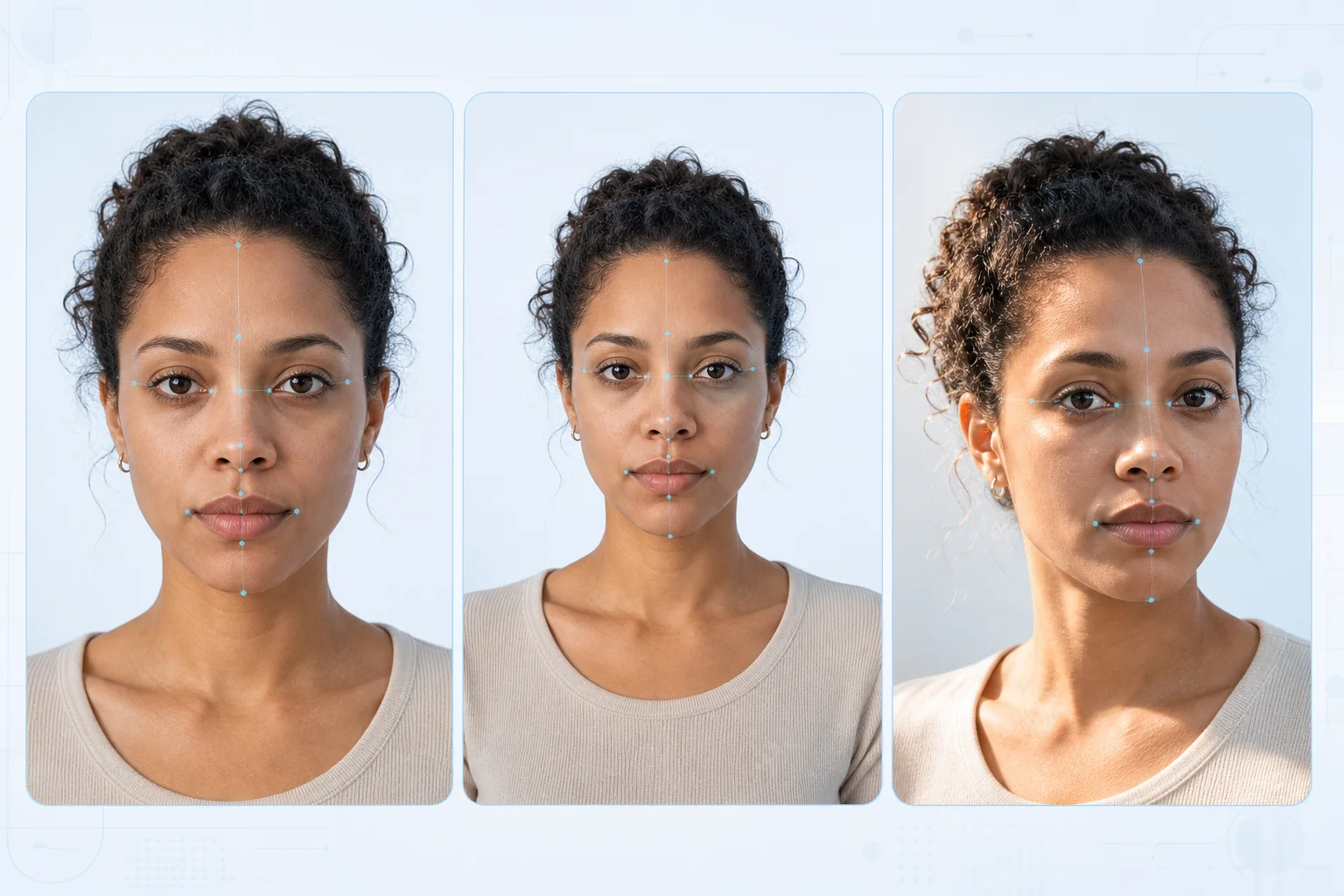
The TikTok trend got it wrong—but the science behind facial harmony is real. Here's how to understand your features with clarity, not comparison.
The Trend That Missed the Point
In 2024, "facial harmony" exploded on TikTok. Over 217 million posts. Users zooming in on their features, then zooming out to declare whether they had "good" or "bad" facial harmony. Conventionally beautiful people labeling themselves "flawed." Comment sections filled with ruthless assessments.
The trend took a legitimate concept—proportional balance between facial features—and turned it into a vehicle for self-scrutiny and public judgment. Cosmetic physicians were blunt in their criticism: "This is yet another disturbing trend with little to no scientific merit," said Dr. Edwina Morgan, a Brisbane-based cosmetic physician. "What ensues in the comment section is even more disturbing, with strangers posting cruel and deprecating commentary."
But here's the thing: the underlying science of facial harmony isn't wrong. The trend was wrong in how it applied it.
Understanding the difference is crucial—because when facial harmony is explored thoughtfully, privately, and with proper context, it becomes a tool for informed self-presentation rather than self-criticism.
What Facial Harmony Actually Means
The Clinical Reality
In clinical aesthetics, facial harmony refers to the balanced, proportional relationship between facial features. It's not about "good" or "bad"—it's about how features work together.
Practitioners assess faces using established frameworks:
Facial Thirds:
- Upper third: Forehead to brow
- Middle third: Brow to nose base
- Lower third: Nose base to chin
Facial Fifths:
- The face divided into five equal vertical segments, using eye width as a unit of measurement
Key Proportional Relationships:
- Eyes ideally one eye-width apart
- Nose aligned with the center of the philtrum
- Chin in balanced relationship with the nose and lips
- Jawline creating appropriate contour and definition
These aren't arbitrary beauty standards. They're observations drawn from decades of clinical experience about what the human brain perceives as naturally balanced.
The Critical Nuance: Harmony ≠ Symmetry
One of the biggest misconceptions—amplified by social media—is that facial harmony means perfect symmetry. It doesn't.
No one has a perfectly symmetrical face. Small differences between the left and right sides are completely normal and can add character. What matters is the overall balance between features—the volume, the contour, how smoothly one feature transitions into another.
A face can be symmetrical but still feel "off" if the cheeks have lost volume or the jawline lacks definition. Conversely, a face with mild asymmetry can look remarkably harmonious when features complement each other well.
The Golden Ratio: Guideline, Not Gospel
The golden ratio (approximately 1.618) has been referenced in art and aesthetics for centuries. In facial aesthetics, practitioners use it as one framework among many for assessing proportion.
But it's a guideline, not a prescription. The ratio helps identify areas that might benefit from enhancement—it doesn't define a universal ideal. Research consistently shows that attractive proportions exist within ranges, not at precise values.
The Problem with TikTok's Approach
Oversimplification
The TikTok trend reduced facial harmony to a binary: "good" or "bad." This oversimplifies the complexity of human beauty.
As Dr. Amy Chahal, founder of The Centre for Medical Aesthetics, explains: "Every individual has unique characteristics that contribute to their overall appearance. What might be perceived as a flaw in one context could be seen as a distinctive and attractive feature in another."
She cites Angelina Jolie as an example: "Her lower face is more masculine than traditional Western standards would categorize as beautiful for women. However, it works quite well for her, making her objectively one of the most beautiful women in the world."
Public Scrutiny
The trend invited public commentary on personal features—something that's fundamentally different from private, informed self-assessment. When strangers judge your face in comment sections, the experience is harmful regardless of what they say.
Missing Context
TikTok's facial harmony trend ignored crucial context:
Cultural Variation: Beauty standards differ dramatically across cultures and eras. What's considered harmonious in one context may differ in another.
Gender Differences: Men and women have different proportional ideals. What works for one may not work for another.
Individual Uniqueness: Features that deviate from "average" can contribute to exceptional beauty when they're in harmony with surrounding features.
The Whole Person: Attractiveness isn't determined by facial proportions alone. Style, voice, personality, how someone carries themselves—all of these contribute to how we perceive others.
The Right Way to Explore Facial Harmony
Private, Not Public
The most important distinction between harmful social media trends and healthy self-exploration is privacy. Understanding your proportions should be a personal journey, not a public performance.
When you analyze your face privately, you can:
- Take your time without external pressure
- Focus on understanding rather than judgment
- Make informed decisions without commentary from strangers
- Maintain control over your own narrative
Educational, Not Judgmental
Quality facial analysis is educational. It explains what proportional relationships mean, provides context about how photo conditions affect results, and offers practical guidance rather than labels.
The goal isn't to receive a "score" or a verdict. It's to understand your unique structure and how different features relate to each other.
Contextual, Not Absolute
Any meaningful analysis must include context:
Photo Quality: Lighting, angle, and clarity all affect detection accuracy. A "bad" result from a poorly lit photo doesn't mean your face is "bad"—it means the photo was inadequate.
Confidence Levels: The best analyses include confidence scores that indicate how reliable the results are. Understanding this context prevents over-interpretation.
Cultural Framework: Analysis should be interpreted within appropriate cultural and ethnic contexts, not against some universal ideal.
Practical, Not Prescriptive
Understanding your proportions should guide practical, low-risk decisions—not prescribe dramatic changes. The most valuable applications are:
Photography: Finding angles and lighting that showcase your natural balance Styling: Choosing hairstyles, glasses, and makeup that enhance proportionality Self-awareness: Understanding how your features work together so you can present yourself with confidence
How Clinical Practice Got It Right
The Holistic Approach
While TikTok reduced facial harmony to individual features, clinical practice takes the opposite approach. Leading practitioners emphasize that no feature exists in isolation.
A rhinoplasty that ignores the chin may create new disharmony. A facelift that doesn't address volume loss may produce an unnatural appearance. The goal is always to enhance the relationships between features—to make sure everything fits together like pieces of a puzzle.
Personalized Assessment
Effective facial balancing begins with a comprehensive assessment of the individual:
- Natural facial architecture
- How aging has affected specific proportions
- What balance looks like for that person's face
- Cultural and ethnic considerations
- Gender-specific ideals
This personalized approach ensures that any enhancement supports the individual's unique structure rather than imposing external standards.
Non-Surgical Evolution
The field has evolved significantly. Modern facial balancing uses:
Dermal Fillers: Strategic placement to restore volume, define contours, and correct mild asymmetries in areas like cheeks, chin, jawline, and under-eyes.
Botox: Relaxing overactive muscles to improve balance, smooth lines, and subtly contour the jawline.
Skin Treatments: Chemical peels, laser therapy, and microneedling to improve texture and tone, providing a clearer canvas that enhances overall harmony.
Profile Balancing: Looking at the relationship between nose, chin, and lips—not just from the front, but from the side.
The key insight is that these treatments work best when they're part of a holistic plan that considers how each element contributes to overall balance.
The Psychological Dimension
Why It Matters
Research consistently shows that when people perceive their features as balanced, they report:
- Higher self-esteem
- Greater social confidence
- Reduced appearance-related anxiety
- More positive social interactions
This isn't vanity. It's psychology. When your external appearance aligns with your internal sense of self, the gap between "how I look" and "how I want to look" narrows, producing genuine psychological relief.
The Confidence Loop
Understanding your proportions creates a positive feedback loop. When you know which features contribute to your overall balance, you can make informed choices about styling, photography, and presentation. This knowledge translates to increased confidence, which itself enhances how others perceive you.
Avoiding the Comparison Trap
The crucial difference is between understanding and comparing. Understanding your own proportions is empowering. Comparing yourself to others—or to impossible standards—is destructive.
Social media trends thrive on comparison. Healthy self-exploration focuses on your own unique structure and how to present it authentically.
Practical Steps for Healthy Exploration
Start with Good Photos
Photo quality dramatically affects any analysis. For the most accurate results:
- Use even, front-facing lighting
- Ensure the photo is straight-on (not angled)
- Remove sunglasses or other obstructions
- Use a neutral expression
- Ensure good resolution and clarity
Focus on Relationships, Not Features
Instead of fixating on individual features, observe how they relate to each other:
- How does your nose relate to your chin?
- Do your eyes appear balanced in the context of your overall face?
- How does your jawline contribute to your facial shape?
Use Insights for Low-Risk Choices
The most valuable applications of facial harmony understanding are low-risk:
- Experimenting with different hairstyles
- Trying new glasses frames
- Adjusting photography angles and lighting
- Exploring makeup techniques that enhance balance
Maintain Perspective
Remember that facial harmony is one dimension of appearance—not a measure of worth. Faces with "imperfect" proportions can be exceptionally attractive, expressive, and memorable. Character, personality, and how you carry yourself matter enormously.
The Technology That Gets It Right
What Modern AI Analysis Offers
Modern AI facial analysis represents a fundamentally different approach from TikTok trends:
Privacy First: Analysis happens in your browser. No public performance, no comment sections, no external judgment.
Educational Focus: Results explain what proportions mean with context and confidence levels—not labels or verdicts.
Comprehensive Assessment: AI evaluates relationships between multiple facial regions simultaneously, not isolated features.
Consistency: The same measurement criteria apply to every analysis, eliminating the subjective variation that affects human assessment.
Actionable Insights: Results guide practical decisions about styling, photography, and self-presentation—not dramatic interventions.
What Gets Measured
| Dimension | What It Reveals |
|---|---|
| Facial Thirds | Balance between upper, middle, and lower face zones |
| Eye Region | Spacing, placement, and regional balance |
| Nose-Mouth Relationship | Central feature proportion context |
| Jaw & Chin | Lower-face contour and balance signals |
| Symmetry | Left-right landmark differences |
| Photo Quality | Lighting, angle, and clarity checks |
The Critical Difference
The difference between healthy facial harmony exploration and harmful social media trends comes down to three principles:
- Privacy over performance: Understanding yourself, not performing for others
- Education over judgment: Learning about your structure, not receiving verdicts
- Context over absolutes: Interpreting results within proper frameworks, not as universal truths
The Bottom Line
The TikTok facial harmony trend got it wrong—not because the science is invalid, but because it applied real concepts in a harmful way. It turned a legitimate tool for self-understanding into a vehicle for public scrutiny and self-criticism.
But the underlying principles are sound. Facial harmony—the balanced, proportional relationship between features—is real, measurable, and meaningful. When explored privately, with proper context, and for the right purposes, it becomes a powerful tool for informed self-presentation.
The goal isn't to achieve some universal ideal. It's to understand your unique structure and use that knowledge to present yourself with confidence. Not because you're trying to look like someone else—but because you're trying to look like the best version of yourself.
As one cosmetic physician puts it: "Trends are fine for fashion, but definitely not for your face." The same applies to how you explore your own proportions. Do it privately. Do it with context. Do it for understanding, not judgment.
That's facial harmony done right.
Ready to explore your own facial harmony—privately, with proper context, and without the noise of social media? Discover your facial balance and see what your proportions reveal about your unique structure.