
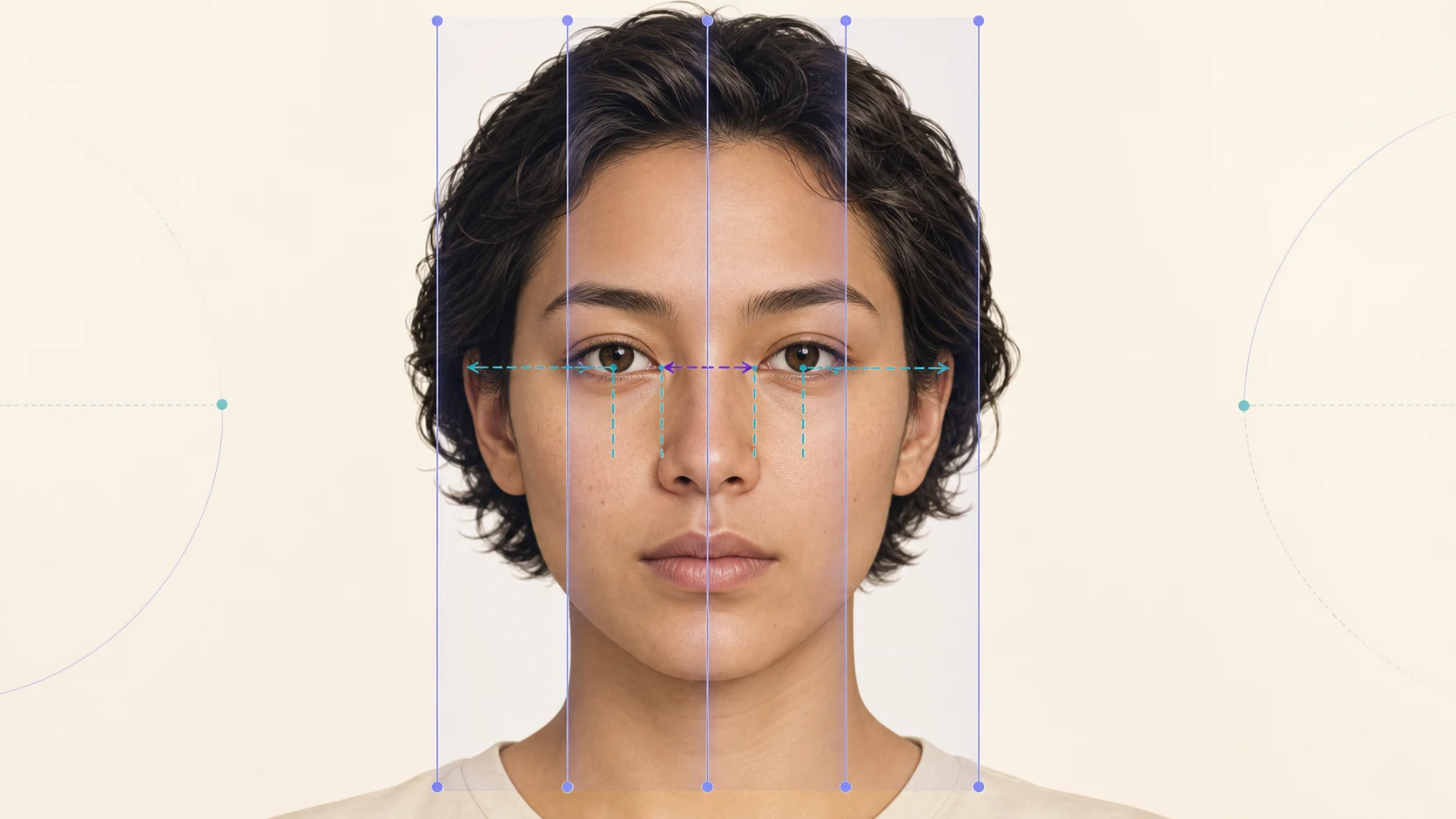
Discover how modern AI analysis can reveal your unique facial proportions—and how to use that insight for natural, confident self-presentation.
What Exactly Is Facial Harmony?
Facial harmony isn't about chasing perfection. It's about understanding how your features—eyes, nose, mouth, jaw—relate to one another in proportion and balance. When these relationships feel coherent, the face reads as naturally attractive, even if individual features aren't "flawless."
Unlike simple symmetry (which only measures left-right balance), facial harmony looks at the bigger picture: how thirds, spacing, and contours work together to create visual coherence.
The Role of Proportion
Proportion is the backbone of facial harmony. Historically, artists and architects have relied on the golden ratio—approximately 1.618—as a reference point for aesthetically pleasing relationships. While no face perfectly matches this mathematical ideal, faces that approximate certain proportional relationships tend to be perceived as more balanced.
Key proportional relationships include:
- Facial Thirds: The face can be divided horizontally into three roughly equal zones—forehead to brow, brow to nose base, and nose base to chin. When these sections are balanced, the face often appears more harmonious.
- Eye Spacing: The distance between the eyes typically aligns with the width of one eye, creating a sense of centered proportion.
- Lower Face Balance: The relationship between the nose, lips, and chin contributes significantly to overall facial coherence.
Symmetry: Important, But Not the Whole Story
Perfect symmetry is rare in nature—and that's okay. Studies consistently show that mild asymmetry can add character and authenticity to a face. What matters more is that the overall balance supports visual harmony, not that every feature mirrors its counterpart exactly.
Why Understanding Your Facial Proportions Matters
Most people don't want a "beauty score." They want clarity—understanding what makes their face unique and how to present it confidently. A structured analysis helps in several practical ways:
1. See the Full Picture, Not Just One Feature
It's easy to fixate on a single perceived flaw. But facial harmony is about relationships. Understanding how your thirds, eye placement, and jawline interact gives you a more complete—and often more positive—perspective.
2. Make Informed, Low-Risk Choices
Insights about your proportions can guide practical decisions: which hairstyles frame your face best, how glasses affect your look, what camera angles work for portraits, or how makeup can enhance balance. These are subtle, reversible adjustments—not medical interventions.
3. Compare Photos Objectively
Lighting, angle, and expression all affect how a face appears in photos. A consistent analysis framework lets you compare images fairly, helping you identify which conditions bring out your best features.
4. Understand Confidence Signals
Rather than receiving a single opaque number, a quality analysis explains why certain proportions appear as they do—and what that means for your overall presentation. Context matters more than a raw score.
How AI-Powered Facial Analysis Works
Modern facial harmony analysis has evolved beyond manual measurement. AI tools can now detect facial landmarks, calculate proportional relationships, and generate detailed reports—all from a single photo.
The Process
- Upload: Start with one clear, front-facing photo with even lighting.
- Analysis: AI detects key facial landmarks and measures proportional relationships.
- Report: You receive a detailed breakdown of your facial thirds, eye region, nose-mouth relationship, jawline, and symmetry—with explanations and confidence levels.
What Gets Measured
A comprehensive facial analysis typically evaluates:
| Dimension | What It Reveals |
|---|---|
| Facial Thirds | Balance between upper, middle, and lower face zones |
| Eye Region | Spacing, placement, and regional balance |
| Nose-Mouth Relationship | Central feature proportion context |
| Jaw & Chin | Lower-face contour and balance signals |
| Symmetry | Left-right landmark differences |
| Photo Quality | Lighting, angle, and clarity checks |
Privacy and Transparency
Modern tools prioritize privacy. The best platforms perform initial analysis directly in your browser, store only structured data (not raw photos unless you opt in), and give you full control over deletion. No public rankings, no shaming—just private, actionable insights.
Practical Steps to Enhance Your Facial Harmony
Understanding your proportions is the first step. Here are practical, low-risk approaches to put that knowledge into action:
Photography and Styling
- Lighting: Even, front-facing lighting minimizes shadows that can exaggerate asymmetry.
- Angle: A straight-on angle provides the most accurate representation of your natural proportions.
- Hairstyle: Frame your face to complement your thirds—a style that balances your upper and lower face can enhance overall harmony.
- Glasses: Choose frames that align with your brow line and don't overwhelm your eye region.
photo and styling choices (not medical facial exercises)
Targeted exercises can help strengthen and tone facial muscles, potentially improving balance over time:
- Smile exercises: Strengthen muscles around the mouth for more balanced expressions.
- Jaw exercises: Focus on the muscles of mastication to define the jawline.
- Lip exercises: Boost circulation and tone for improved shape and fullness.
Consistency matters more than intensity—regular, gentle practice yields better results than occasional intense sessions.
Skin Health
Healthy skin enhances facial harmony by providing a clear, even canvas:
- Hydration: Well-moisturized skin appears plumper and more radiant.
- Sun protection: Prevents uneven pigmentation and premature aging.
- Targeted treatments: professional skincare routines discussed with a qualified clinician.
When to Consider Professional Guidance
For significant structural concerns, consulting with a qualified professional can help you understand your options. However, many people find that photography adjustments, styling choices, and consistent skincare provide meaningful improvements without invasive procedures.
Putting It All Together
Facial harmony isn't about conforming to a single standard of beauty. It's about understanding the unique relationships between your features and using that knowledge to present yourself with confidence.
Whether you're preparing for a professional portrait, exploring new styling choices, or simply curious about your proportions, a structured analysis provides the clarity you need—without judgment, without medical claims, and without public exposure.
The goal isn't perfection. It's understanding—and that understanding empowers you to make choices that feel authentic and confident.
Ready to explore your own facial proportions? A free preview can show you whether photo quality is right for analysis, with no commitment required. Try a facial harmony analysis and see what your proportions reveal.