
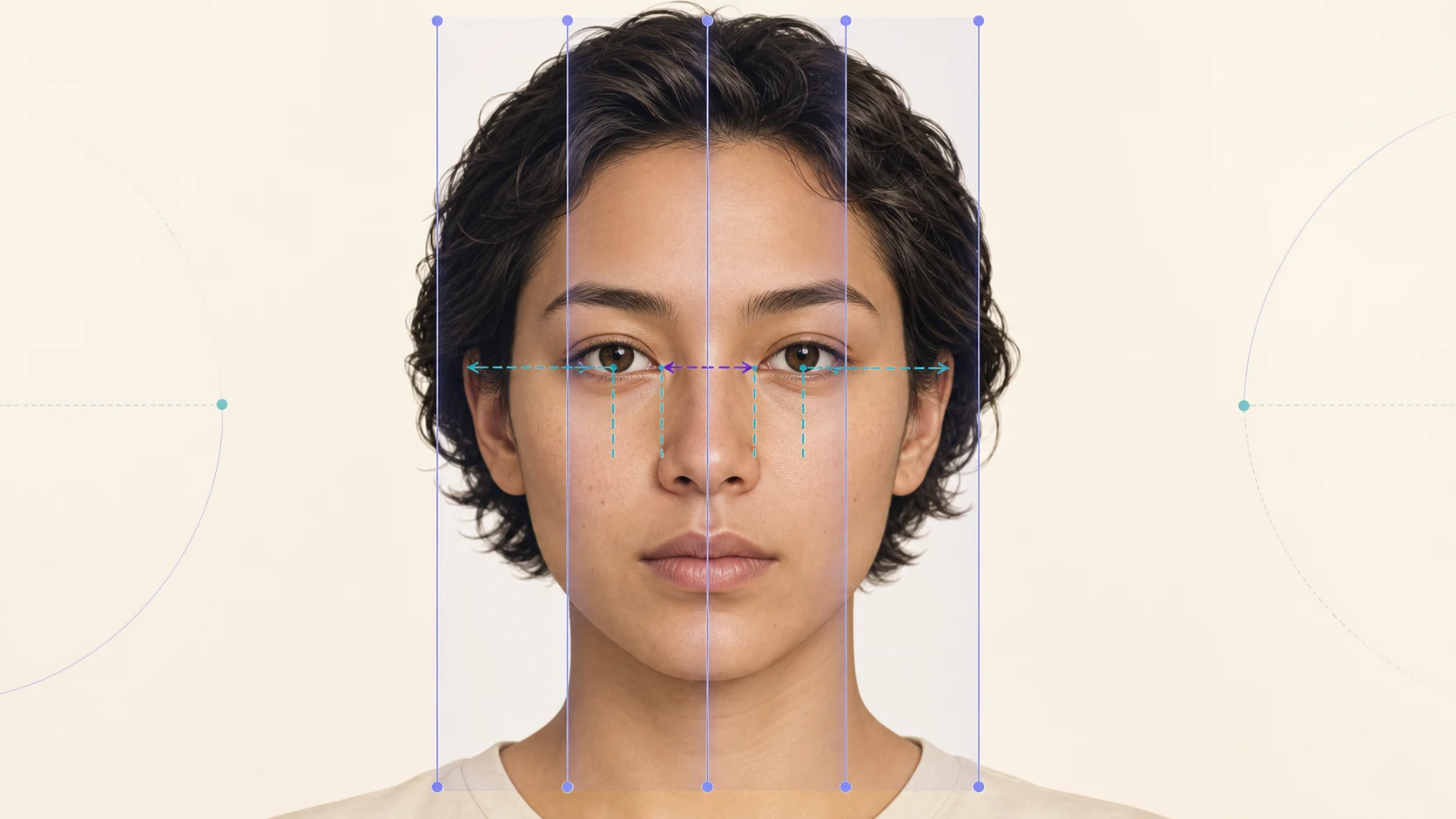
When looking at a front-facing photo, people often ask whether the eyes are widely or narrowly spaced, how much of the face one eye occupies, or why nose width is compared with eye spacing. Facial fifths, sometimes called the five-eye rule, is a classical framework for describing these horizontal relationships. It is a map for observation, not a geometric test that a face must pass.
The short answer
The classical facial-fifths model treats the visible face as roughly five eye-widths across: the center zone spans the inner corners of the eyes, the two adjacent zones contain the eyes, and the outer zones extend from each outer eye corner to the visible side of the face. Real faces rarely form five exactly equal zones, so the model should be used as a historical reference rather than a universal ideal.
| Observation | What it describes | Common misconception |
|---|---|---|
| Single-eye width | Visible distance from the inner to outer corner of one eye | Both eyes must be exactly equal |
| Inner canthal distance | Distance between the two inner eye corners | It must equal exactly one eye width |
| Outer zones | Space from each outer eye corner to the visible facial edge | Both sides must form identical rectangles |
| Nasal width | Distance between the outermost points of the nasal wings | It must equal inner canthal distance for everyone |
What are facial fifths?
The usual diagram draws six vertical guides through the left facial edge, left outer eye corner, left inner eye corner, right inner eye corner, right outer eye corner, and right facial edge. Those guides create five zones: the left outer face, left eye, central eye spacing, right eye, and right outer face.
In the classical model, the five zones are treated as approximately similar in width. The important word is approximately. The framework supplies coordinates for discussing eye width, eye spacing, and face width; it does not require pixel-perfect equality.
| Zone | Approximate span | Use |
|---|---|---|
| Left outer zone | Left facial edge to left outer eye corner | Relates the eye to the side of the face |
| Left eye zone | Left outer to inner eye corner | Visible left-eye width |
| Center zone | Between the inner eye corners | Inner canthal distance |
| Right eye zone | Right inner to outer eye corner | Visible right-eye width |
| Right outer zone | Right outer eye corner to facial edge | Relates the eye to the side of the face |
Eye width, eye spacing, and inner canthal distance
Eye width
Eye width is the visible horizontal distance from the inner corner (endocanthion) to the outer corner (exocanthion) of one eye. It describes the opening of the eye, not eyeball diameter or eyebrow length. Expression, squinting, makeup, lashes, hair, and image clarity can all affect landmark detection.
Inner canthal distance
Inner canthal distance is the distance between the two inner eye corners—usually what everyday discussion means by eye spacing. The fifths model compares this distance with a single eye width. A larger or smaller value is a geometric description, not a defect and not evidence about health, personality, identity, or worth.
Average eye width
The two visible eye widths may differ slightly because of pose, blinking, expression, or landmark error. A photo analysis can reduce incidental variation by comparing both eyes and using their average when relating eye spacing to eye width.
Why is nose width compared with eye spacing?
Classical proportion systems often compare nasal width—the distance across the outermost nasal wings—with inner canthal distance. The two may be described as similar in a traditional model, but similar does not mean universally equal.
- Nasal width and inner canthal distance can be observed as one horizontal relationship.
- A result should describe their relative size rather than label it pass or fail.
- A front-facing image shows visible two-dimensional relationships and cannot replace three-dimensional measurement or medical examination.
How to observe facial fifths in one photo
- Choose a suitable photo. Use a clear, front-facing image with a relaxed expression, visible eye corners, and no obvious head tilt. Avoid close wide-angle selfies, filters, severe cropping, and strong side lighting.
- Check the facial midline. The eyes should be roughly level and the nose and mouth close to center. A head turn makes the near side look wider and compresses the far side.
- Mark the four eye corners. Use the actual turning points of the eye openings, not eyeliner, eyelashes, or shadow edges.
- Estimate the visible facial edges. At approximately eye level, note that hair, temples, cheek contour, cropping, and pose make facial-edge landmarks less stable than eye corners.
- Compare relationships, not perfect equality. Compare the two eye widths, inner canthal distance versus average eye width, the outer zones, nasal width, and the confidence supported by the photo.
If a result resembles the classical framework, describe it as close to that reference. If it differs, identify which relationship differs instead of calling the whole face proportionally wrong.
Should every face equal five eye widths?
No. The five-eye rule belongs to a neoclassical system of idealized facial proportions. Measurements across different populations show that assumptions involving eye width, inner canthal distance, and nasal width do not apply consistently to every sample.
Horizontal proportions vary with genetics and development, population background, age-related soft-tissue change, average sex-related morphology, eyelid and expression state, landmark definitions, and the difference between direct measurement, 3D scanning, and a 2D photo. Facial fifths are therefore better at answering “how do these regions relate?” than “does this face meet the one correct standard?”
Why selfies change apparent eye spacing and facial fifths
Camera distance
Close-range perspective can enlarge the nose and central face relative to the sides. Even if eye-corner landmarks remain clear, the visible relationship among nasal width, face width, and the outer zones can change.
Head rotation, tilt, and camera height
A small turn changes the outer zones, while a tilted head or unlevel camera mixes vertical displacement into horizontal distances. These conditions make left-right comparisons unreliable.
Expression, occlusion, and image quality
Smiling, squinting, blinking, reflections, hair, shadow, blur, and beauty filters can shift or obscure landmarks. A responsible system should lower confidence when the evidence is weak rather than return an overly certain conclusion.
How AI estimates eye spacing and facial fifths
A photo-analysis system generally locates the inner and outer eye corners, nasal wings, and facial outline, then calculates distances or ratios from their coordinates. An explainable flow can:
- check for one clear, nearly front-facing face;
- estimate head rotation and tilt;
- locate the four eye corners;
- calculate left-eye width, right-eye width, and inner canthal distance;
- compare eye spacing with average eye width;
- describe visible face-width and nasal-width relationships; and
- report confidence based on pose, occlusion, and clarity.
The landmarks are estimates, facial edges are especially sensitive to hair and pose, and a 2D image cannot fully represent 3D anatomy. Useful reports show the visible evidence and confidence rather than only an ideal/not-ideal label.
How to interpret your eye-spacing result
Confirm the measurement
Check whether the result uses inner canthal distance, interpupillary distance, or another eye measurement. These are different quantities and should not be mixed.
Check the reference
Find out whether eye spacing is compared with one eye, average eye width, face width, or nasal width. A distance without a clear denominator says little about proportion.
Review confidence and whole-face context
Retake a rotated, tilted, obscured, or strongly distorted photo before interpreting small differences. Eye spacing is one horizontal relationship; facial thirds, brow-eye relationships, the nose, lips, jaw, expression, and photo context also shape the complete picture.
Words such as wider or narrower only describe geometry relative to a named reference. They do not mean better or worse, and they do not imply a need for treatment or change.
Common measurement errors
- Using interpupillary distance as eye spacing: the central fifth uses the inner eye corners, not pupil centers.
- Using eyeball size as eye width: the comparison uses the visible opening from inner to outer eye corner.
- Using hair as the facial edge: hairstyles make outer-zone landmarks unstable.
- Demanding precision from a close selfie: perspective changes relative scale.
- Turning a classical ratio into a beauty score: fifths describe one part of facial geometry and cannot determine attractiveness.
Frequently asked questions
What are facial fifths?
Facial fifths are a classical horizontal proportion framework that uses the eye corners and visible facial edges to divide a front-facing face into five approximate zones.
Should normal eye spacing equal one eye width?
Inner canthal distance close to one eye width is a classical reference, not a universal normal standard.
Are eye spacing and interpupillary distance the same?
No. This guide uses the distance between the inner eye corners; interpupillary distance uses the centers of the pupils.
Must nasal width equal inner canthal distance?
No. They can be compared, but strict equality is not a universal rule.
Why do two photos produce different ratios?
Camera distance, pose, expression, occlusion, filters, image quality, and landmark error can all change a two-dimensional estimate.
Can AI measure facial fifths accurately?
AI can estimate visible landmarks in a suitable front-facing image, but the result remains sensitive to pose, perspective, clarity, and method.
Can facial fifths determine attractiveness?
No. They describe selected horizontal relationships and cannot measure health, personality, identity, worth, or universal beauty.
Use fifths to understand relationships—not to find a standard face
The value of facial fifths is that they make eye width, eye spacing, nasal width, and face width easier to discuss. They provide a shared vocabulary, not a template everyone must copy.
To place eye spacing within the full composition, read What Is Facial Harmony?, then analyze a clear front-facing photo with FacialHarmonyAI. Review landmark evidence and photo confidence first, and treat proportion labels as descriptions rather than verdicts.