
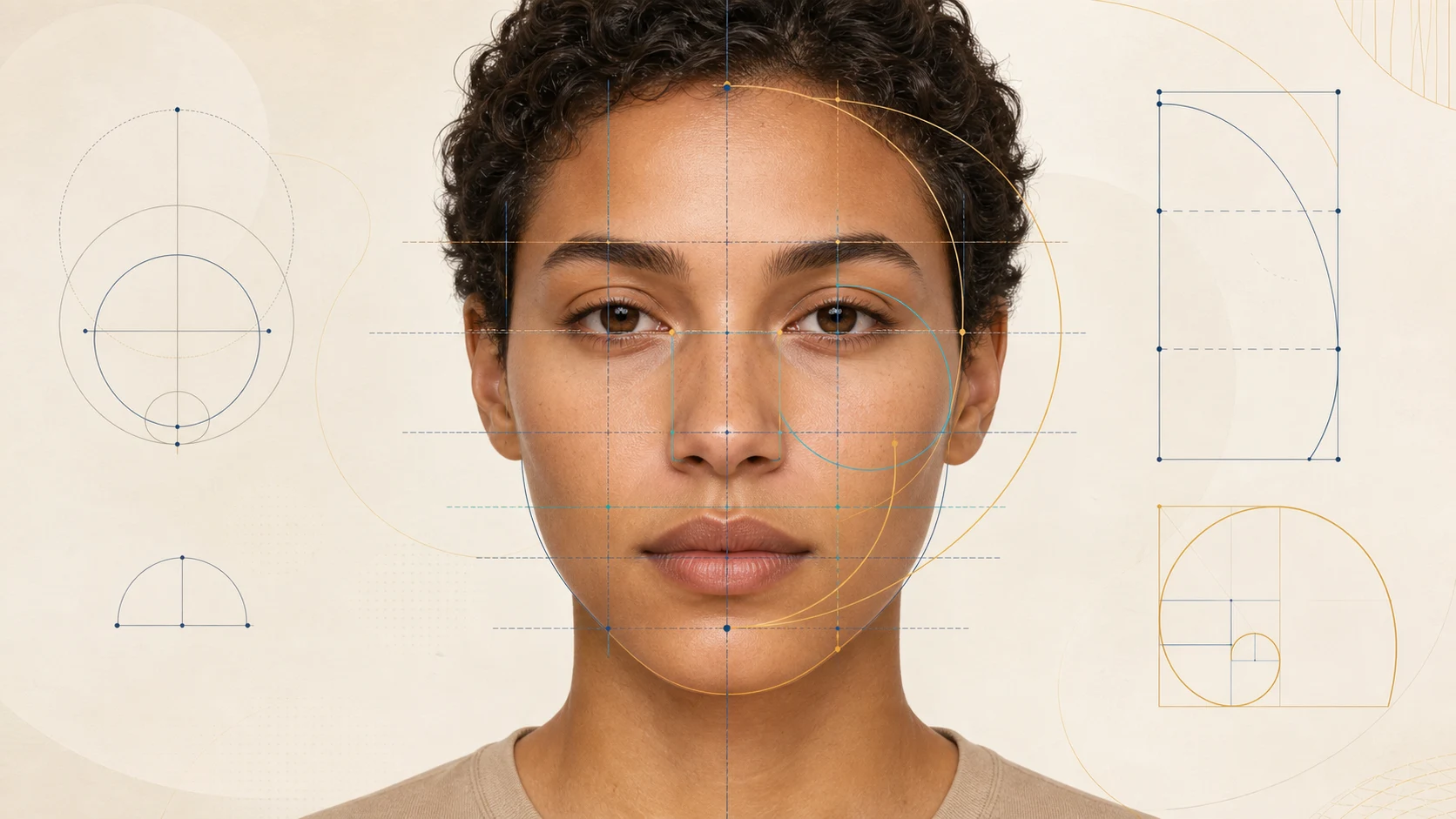
An evidence-based exploration of how facial proportions shape perception—and how AI analysis can help you understand your own unique balance.
The Enigma of Facial Harmony
Facial harmony is one of those concepts that everyone intuitively recognizes but few can precisely define. When we see a face that "just works"—where the eyes, nose, lips, and jaw seem to fit together effortlessly—we experience a sense of rightness that transcends any single feature.
Yet in scientific literature, facial harmony has remained surprisingly elusive. Researchers have studied symmetry, averageness, and proportionality extensively, but harmony itself—the way these elements come together as a unified whole—has received less direct attention. This article explores what we actually know about facial harmony, why it matters, and how modern analysis tools can help you understand your own facial balance.
What Is Facial Harmony? A Working Definition
Drawing from philosophy, clinical practice, and contemporary research, we can define facial harmony as:
> The extent to which facial features and soft tissues form a balanced, integrated whole, such that no feature appears disproportionately salient and the overall configuration is easy and pleasant for observers to process.
This definition emphasizes relationships over individual features. A small nose isn't inherently good or bad—what matters is whether it fits with the jaw, whether the jaw complements the midface, and whether soft tissue volumes support the underlying bone structure in a consistent way.
Clinical Perspectives
In orthodontics, orthognathic surgery, and aesthetic medicine, harmony is typically defined through measurable relationships between facial segments rather than as a standalone quality. Research by Farkas and others has established large databases of soft tissue distances and angles across different ethnic groups, revealing that "harmonious" faces share key measurements that fall within typical ranges for their sex and population—not that they hit a single ideal number.
Studies of facial normality have found that faces considered acceptable by at least 90% of observers tend to share certain characteristics:
- Roughly equal heights of upper, middle, and lower facial thirds
- Relatively narrow noses in women and average-width noses in men
- Profiles that are straight or only slightly retrusive/prominent depending on sex
- Five specific facial proportions related to the golden ratio, but always within ranges, not at precise values
The conclusion? There is indeed a standard perception of "facial normality," but it's expressed as bands of proportional values, not a single template.
Why Does Facial Harmony Captivate Us?
The Sum of Beauty Cues
Facial harmony is attractive largely because it captures several well-established predictors of beauty in one unified concept. A harmonious face is typically:
- Close to the local average configuration: Our visual system has learned prototypes from experience, and faces near these prototypes feel familiar
- Reasonably symmetric: Symmetry reduces random developmental noise
- Proportionate: Key features relate to one another within plausible size and spacing ranges for that sex and population
When these ingredients align, observers experience the result as a single, coherent whole rather than a collection of competing features.
The Processing Fluency Hypothesis
From a cognitive perspective, harmonious faces are attractive because they're easy to perceive and process. Research shows that faces closer to prototypes elicit faster and smaller neural responses and are rated as more pleasant—an effect known as processing fluency.
Proportionality studies find that attractiveness peaks in flexible "sweet spots" rather than at extremes. Faces that sit in these balanced bands give the visual system a familiar pattern to work with, making recognition and categorization feel almost effortless.
In simple terms: a harmonious face feels easier to take in at a glance, which quietly boosts attractiveness even when observers can't articulate what changed.
The Good Genes Theory
There's also a biological dimension. Faces defined as harmonious are generally high in averageness and symmetry—concepts linked (albeit imperfectly) to developmental stability and the absence of major genetic or environmental insults.
Balanced proportions in the vertical and horizontal thirds are associated with typical craniofacial growth, while very unusual ratios can accompany clinical conditions. A harmonious face—one that sits within ordinary proportional ranges, shows no glaring asymmetries, and expresses sex-typical traits moderately—functions as a composite cue that underlying development was broadly on track.
The Benefits of Facial Harmony
Facial harmony doesn't just make a face more pleasant to look at. Because it integrates proportionality, symmetry, and averageness into a coherent whole, it shapes how others respond to you and how you respond to yourself.
The "Brain Fluency" Effect
The most direct benefit is a higher baseline level of perceived attractiveness. When features form a balanced, coherent configuration, observers tend to rate the face as more attractive and easier to look at. This is partly because harmonious faces sit closer to population averages for key proportions, and partly because they avoid extreme asymmetries or disproportionate segments that stand out as "off."
The Halo Effect
Research consistently shows that facial attractiveness influences perceptions across multiple domains. Faces perceived as harmonious often benefit from assumptions of competence, warmth, and trustworthiness—a phenomenon known as the halo effect. While these associations don't reflect actual character traits, they shape social interactions in measurable ways.
The Confidence Loop
Understanding your facial proportions can create a positive feedback loop. When you know which features contribute to your overall balance, you can make informed choices about styling, photography, and presentation. This knowledge often translates to increased confidence, which itself enhances how others perceive you.
Why Harmony Is Hard to Study Scientifically
Despite its intuitive appeal, facial harmony presents significant challenges for researchers:
The Definition Problem
Unlike symmetry (which can be measured precisely as left-right differences) or averageness (which can be calculated against population norms), harmony is inherently relational and multidimensional. There's no single metric that captures "how harmonious" a face is.
The Interaction Effect
Harmony emerges from the interaction of multiple features, not from any single measurement. A face can have excellent symmetry but poor harmony if proportions are extreme, or moderate asymmetry but strong harmony if features complement each other well.
Cultural and Ethnic Variation
What constitutes "harmonious" varies across populations. Research shows that attractive proportions differ between ethnic groups, and that beauty standards are anchored in local population norms rather than universal ideals. This means harmony must always be assessed relative to a specific context.
Modern Approaches to Understanding Your Facial Harmony
Given these complexities, how can you gain meaningful insight into your own facial balance?
Traditional Methods
Historically, understanding facial proportions required either:
- Professional consultation with orthodontists or aesthetic specialists
- Manual measurement using calipers and anthropometric landmarks
- Subjective assessment based on artistic principles
These approaches have limitations: they're either expensive, time-consuming, or inconsistent.
AI-Powered Analysis
Modern facial analysis tools leverage artificial intelligence to detect facial landmarks, calculate proportional relationships, and generate detailed reports—all from a single photograph. This approach offers several advantages:
Consistency: AI applies the same measurement criteria to every analysis, eliminating subjective variation.
Comprehensive Assessment: Rather than focusing on a single feature, AI evaluates relationships between multiple facial regions simultaneously.
Privacy-First Design: The best platforms perform analysis directly in your browser, store only structured data (not raw photos unless you opt in), and give you full control over deletion.
Actionable Insights: Rather than providing a single "beauty score," quality AI analysis explains what specific proportions mean for your overall presentation.
What Gets Measured
A comprehensive AI facial analysis typically evaluates:
| Dimension | What It Reveals |
|---|---|
| Facial Thirds | Balance between upper, middle, and lower face zones |
| Eye Region | Spacing, placement, and regional balance |
| Nose-Mouth Relationship | Central feature proportion context |
| Jaw & Chin | Lower-face contour and balance signals |
| Symmetry | Left-right landmark differences |
| Photo Quality | Lighting, angle, and clarity checks |
Practical Applications: Using Harmony Insights
Understanding your facial proportions isn't about conforming to a single standard—it's about making informed choices that enhance your natural balance.
Photography and Styling
- Lighting: Even, front-facing lighting minimizes shadows that can exaggerate asymmetry
- Angle: A straight-on angle provides the most accurate representation of your natural proportions
- Hairstyle: Frame your face to complement your thirds—a style that balances your upper and lower face can enhance overall harmony
- Glasses: Choose frames that align with your brow line and don't overwhelm your eye region
Low-Risk Enhancements
- Makeup: Strategic application can enhance proportionality—contouring, highlighting, and color placement all affect perceived balance
- Facial exercises: Targeted exercises can help strengthen and tone facial muscles, potentially improving balance over time
- Skincare: Healthy skin provides a clear, even canvas that enhances overall facial coherence
When to Seek Professional Guidance
For significant structural concerns, consulting with qualified professionals can help you understand your options. However, many people find that photography adjustments, styling choices, and consistent skincare provide meaningful improvements without invasive procedures.
The Limitations of Harmony
It's important to acknowledge what facial harmony analysis cannot do:
It's Not a Medical Diagnosis
Facial harmony analysis is an educational tool, not a clinical assessment. It doesn't diagnose conditions, recommend treatments, or predict health outcomes.
It Doesn't Define Your Worth
Proportional balance is one dimension of facial appearance, not a measure of character, intelligence, or value. Faces with "imperfect" proportions can be exceptionally attractive, expressive, and memorable.
It's Influenced by Photo Quality
AI analysis depends on the quality of input images. Lighting, angle, expression, and occlusion all affect detection accuracy. The best analyses include confidence scores that indicate how reliable the results are.
It Reflects Cultural Context
Beauty standards vary across cultures and change over time. What's considered harmonious in one context may differ in another. Analysis should be interpreted within appropriate cultural and ethnic frameworks.
Conclusion: Harmony as a Design Principle
Facial harmony is best understood not as a fixed score or universal ideal, but as a design principle that integrates multiple evidence-based pillars of attractiveness. It helps prioritize subtle, multi-region changes that improve overall balance rather than isolated modifications that might disrupt coherence.
The goal isn't to achieve some Platonic ideal of perfect proportions. It's to understand the unique relationships between your features and use that knowledge to present yourself with confidence.
Whether you're preparing for a professional portrait, exploring new styling choices, or simply curious about your proportions, a structured analysis provides the clarity you need—without judgment, without medical claims, and without public exposure.
The beauty of facial harmony lies in its wholeness. It's not about any single feature—it's about how everything comes together. And understanding that wholeness is the first step toward presenting your most confident, authentic self.
Ready to explore your own facial harmony? A free preview can show you whether photo quality is right for analysis, with no commitment required. Discover your facial balance and see what your proportions reveal about your unique harmony.