
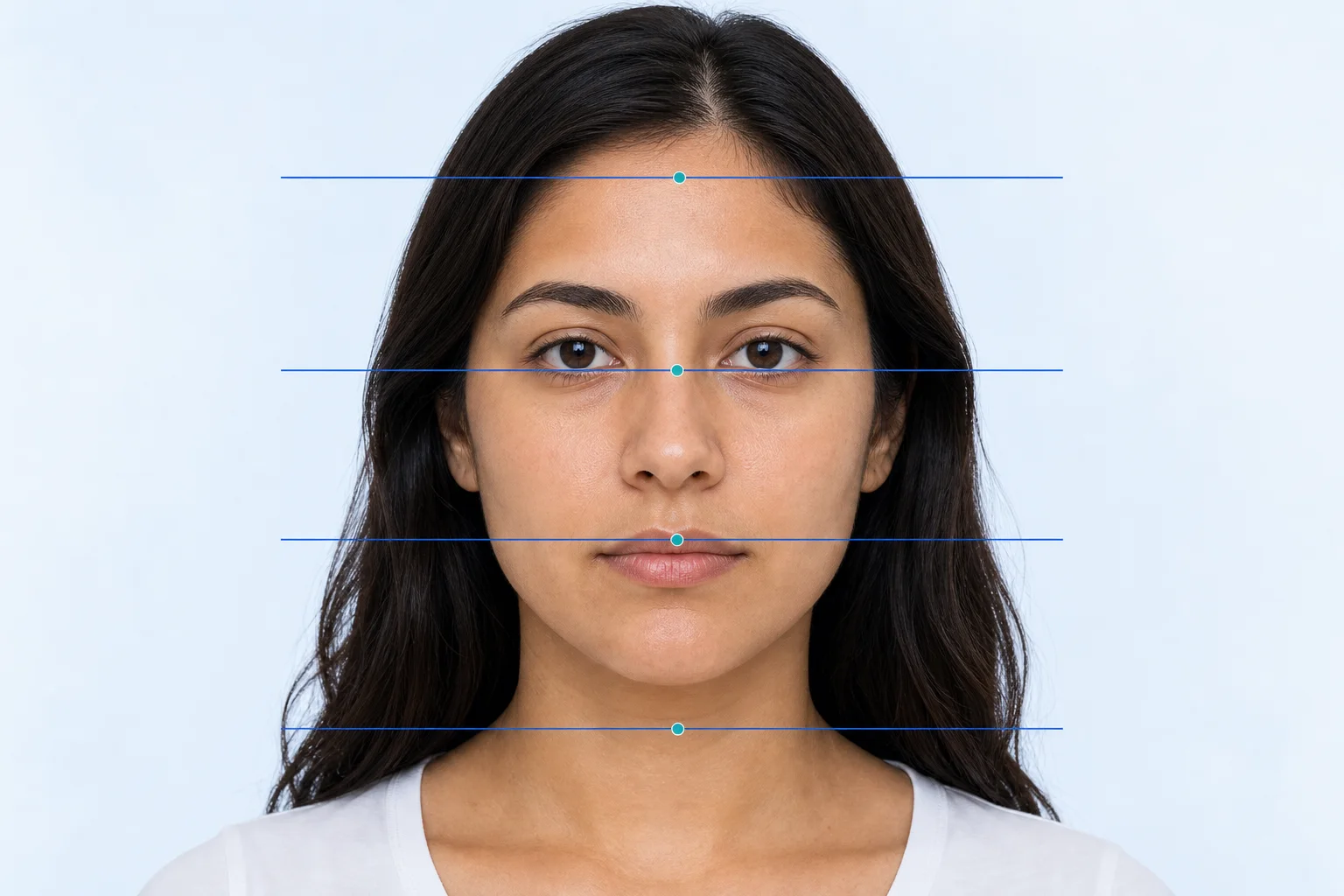
Facial thirds are a common way to describe vertical facial proportions. The face is divided into upper, middle, and lower regions and their visible lengths are compared. The difficulty is that different tools may use different boundaries. This guide uses one fixed convention and treats 1:1:1 as a descriptive reference, not a standard every face must meet.
The short answer
Mark four midline landmarks: the center hairline, the nasion at the nasal root, the subnasale at the base of the nose, and the lowest visible midline chin region. Hairline to nasion is the upper third, nasion to subnasale is the middle third, and subnasale to chin is the lower third. Measure all three in pixels on the same front-facing photo, then express them as a ratio or as percentages of their total.
| Region | Start and end |
|---|---|
| Upper third | Center hairline to nasion |
| Middle third | Nasion to subnasale |
| Lower third | Subnasale to lowest visible chin region |
What are facial thirds?
Facial thirds are a vertical partitioning framework. They describe how the visible height from the hairline to the chin is distributed; they do not directly measure symmetry or define overall facial harmony.
The framework is simple, but it has limits: landmark conventions differ, the hairline is not a fixed bony point, a single photo contains perspective error, and historical equal-division rules do not represent every population or individual.
The four landmarks used in this guide
Trichion: center hairline
The trichion is the midline region where forehead skin meets the hairline. Bangs, an irregular or receding hairline, shadow, and incomplete framing can make it uncertain.
Nasion: nasal root
The nasion is the midline depression where the upper nose meets the forehead. In a photo it is near the bridge between the eyes.
Subnasale: base of the nose
The subnasale is the midline junction beneath the nasal columella and above the upper lip. It is not the nose tip or the lowest edge of a nostril.
Gnathion: chin endpoint
For an ordinary front photo, use the lowest visible midline chin region consistently. This is an image-based operational landmark, not a precise three-dimensional anatomical measurement.
Why landmark conventions matter
Nasion versus glabella
Some art and appearance frameworks use the glabella between the brows instead of the nasion. These are not identical points. Either may belong to a defined method, but do not mix them within one measurement or compare their numbers as if they were the same metric.
Gnathion versus menton
Strict anatomical definitions distinguish gnathion and menton. A consumer photo cannot reliably resolve every subtle three-dimensional difference, so the method should state its visible chin endpoint and use it consistently.
Prepare the photo before measuring
Use one person, a front-facing head, a camera near eye level, a level eye line, a relaxed closed-mouth expression, even light, and a clear view of the hairline, nasal root, nose base, and chin. Turn off reshaping and beauty filters and avoid extreme close-up selfies.
See the photo guide for accurate AI face analysis for a repeatable setup.
How to measure facial thirds manually
- Check that the eye line is nearly level and the bridge of the nose is near the image center.
- Mark the center hairline, nasion, subnasale, and lowest visible midline chin point.
- Record vertical pixel distances:
U = nasion − hairline,M = subnasale − nasion, andL = chin − subnasale. - Write the result as
U:M:L, or divide each value by the middle third. - For percentages, calculate
T = U + M + L, then divide each region byT.
Pixels are sufficient because the goal is to compare relative distances within one image. Converting to centimeters does not remove photo error.
Does 1:1:1 mean the thirds must be equal?
No. 1:1:1 is an idealized historical reference that helps describe which region appears relatively longer or shorter. Real faces vary with hairline shape, age, forehead and nose dimensions, jaw and soft tissue relationships, population background, expression, and photography.
Prefer statements such as “the three visible regions are relatively close” or “the lower third is longer under this convention.” Do not label a natural difference as passing or failing.
How to interpret a relatively longer region
Relatively longer upper third
This describes a longer photo distance from hairline to nasion. Hairline position, hairstyle, camera pitch, and landmark choice may contribute.
Relatively longer middle third
This describes a longer nasion-to-subnasale distance. Head pitch and substituting the glabella for the nasion can change it.
Relatively longer lower third
This describes a longer subnasale-to-chin distance. An open mouth, jaw tension, upward camera angle, and chin endpoint can change it.
No single region determines overall harmony. Read it with facial fifths and eye spacing, symmetry, contour, and photo confidence.
What if the hairline is hidden or receding?
Do not use the edge of bangs as the hairline. Move hair away and retake the photo when possible. With an irregular hairline, use the center region and record uncertainty rather than choosing a point that makes the thirds look more equal.
If the hairline is completely invisible, a complete upper third cannot be measured reliably. You may still describe the middle and lower regions, but do not call the result a complete facial-thirds ratio.
How angle and expression change facial thirds
| Condition | Likely image effect | Better response |
|---|---|---|
| High camera or lowered head | Forehead and middle/lower projection change | Retake near eye level |
| Low camera or raised head | Nose base and lower third become more exposed | Return the head to neutral |
| Head tilt | Landmarks no longer share one vertical path | Correct the pose during capture |
| Close distance | Central perspective is exaggerated | Step back and crop |
Smiling, opening or pursing the lips, clenching the jaw, projecting the chin, raising the brows, and squinting can also move landmarks. Use the same relaxed expression for comparisons.
Why do facial-thirds tools disagree?
One tool may use nasion while another uses glabella; one may use gnathion while another uses menton. Hairline detection, pose correction, crop, rotation, mirroring, rounding, and low-confidence handling may also differ. Confirm the measurement definition before comparing results.
Facial thirds versus facial fifths
| Framework | Direction | Main question |
|---|---|---|
| Facial thirds | Vertical | How are hairline, nasal root, nose base, and chin distributed? |
| Facial fifths | Horizontal | How do the eyes, eye spacing, and face width relate? |
| Symmetry | Left-right | How closely do visible paired landmarks correspond? |
| Facial harmony | Multiple relationships | How do proportions, symmetry, and contour work together? |
How to read an AI facial-thirds analysis
- Check photo pose, level, distance, and clarity.
- Verify all four landmark positions.
- Find out whether the tool uses nasion or glabella.
- Check its chin endpoint convention.
- Look for hairline uncertainty and confidence warnings.
- Identify whether it reports pixels, normalized ratios, or reference ranges.
- Read the result with other proportions and image evidence.
A responsible analysis explains the measurement basis instead of presenting a context-free “standard score.”
Common measurement mistakes
- Using the top of the eyebrow as the nasal root without defining the method.
- Using the nose tip instead of the subnasale.
- Rotating a tilted photo without correcting the original three-dimensional pose.
- Comparing a close selfie with a distant rear-camera photo.
- Treating departure from equal thirds as a defect.
Frequently asked questions
What are the three facial thirds?
The upper, middle, and lower regions: hairline to nasion, nasion to nose base, and nose base to chin under this guide’s convention.
What is the standard facial-thirds ratio?
The historical reference is often written as 1:1:1, but it is not a universal standard.
Should the middle third start at the eyebrows or nasal root?
It depends on the stated convention. This guide uses the nasion. Do not mix methods.
Can I measure if the hairline is hidden?
Not a complete three-part ratio reliably. Retake the photo or report only the visible middle and lower regions.
Can a phone photo be used?
Yes, for a two-dimensional estimate when the photo is clear, front-facing, level, appropriately distant, and unwarped.
Do unequal thirds mean the face is not harmonious?
No. Facial thirds are one vertical reference among many relationships.
Can facial thirds diagnose health or treatment needs?
No. Consumer photo measurement is not a medical, dental, or cosmetic diagnosis.
Use facial thirds as a ruler, not a scorecard
The aim is not to force a perfect 1:1:1. It is to use clearly defined landmarks and compare the three vertical regions consistently in a suitable photo. If the hairline is hidden, the pose is pitched or tilted, or a reshaping filter is active, lower confidence or retake the image.
Continue with the golden-ratio face guide and facial harmony guide, or analyze a clear front-facing photo with FacialHarmonyAI. This article is educational and is not medical advice.