
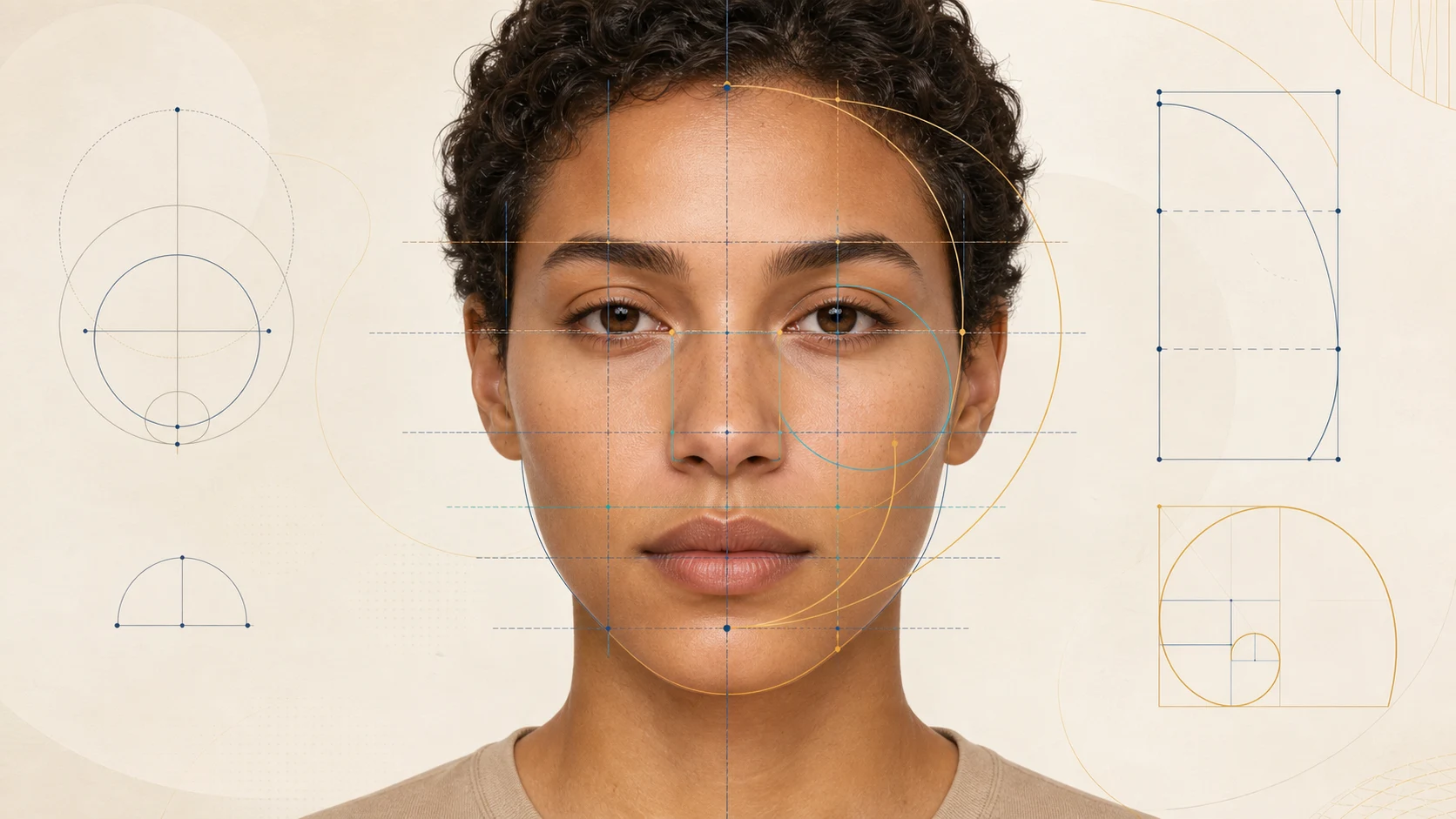
A golden-ratio face test may give you a percentage, place a geometric mask over your photo, or claim that the closer a measurement is to 1.618, the more attractive it is. The precision is persuasive, but it combines two different ideas. The golden ratio is a real mathematical relationship; the claim that every attractive face follows one universal golden ratio is not supported by reliable evidence.
The short answer
The golden ratio, written as φ (phi), is approximately 1.618. A golden-ratio face test divides selected facial distances and checks whether the result approaches φ or its reciprocal. Different tools select different landmarks, measurement pairs, weights, and tolerances, so the same photo can receive very different scores.
| Question | More accurate answer |
|---|---|
| Is the golden ratio real? | Yes. It is a defined mathematical ratio. |
| Can facial distances approach 1.618? | Yes, but one approximate match does not make an entire face golden. |
| Do all attractive faces match phi? | No reliable evidence supports that universal claim. |
| Does a higher score mean more attractive? | No. It only means closer to one tool's chosen rules. |
What is the golden ratio?
Suppose a line is divided into a longer part a and a shorter part b. The golden ratio appears when (a + b) / a = a / b ≈ 1.618. This number is usually written as φ.
Moving from mathematics to a face requires human choices: which landmarks to use, which distances to compare, whether to measure a front view, profile, or 3D scan, how close a value must be to count, and how much each ratio contributes to a total score. Change those choices and the result changes. A golden-ratio face is therefore not one formula naturally written into every face; it is a comparison defined by a method.
How is phi applied to a face?
Calculators and masks do not use one standard measurement set. They may compare face length with face width, hairline-to-chin distance with brow-to-chin distance, lower-face segments, mouth width with nasal width, eye spacing with eye width, or one region with an adjacent region.
Single ratios
A single ratio answers a narrow question, such as whether face length divided by face width approaches a reference. It cannot represent the whole face or prove that the ratio causes attractiveness.
Composite scores
A composite combines several measurements. It looks more complete, but introduces more choices: included ratios, weights, tolerances, and treatment of missing landmarks.
The golden mask
A golden mask is a predesigned template for the eyes, nose, lips, face outline, and jaw. Overlaying it can visualize differences, but the mask reflects its designer's selected shape and alignment. A different mask, scale, or anchor can produce a different result on the same face.
Why is the golden-ratio face idea so persuasive?
- It is memorable. One famous number travels more easily than dozens of interacting facial relationships.
- It looks objective. Decimals, lines, and percentages create an impression of precision.
- It is easy to visualize. A geometric overlay immediately looks analytical.
Visual precision is not the same as a reliable conclusion. Fine lines do not explain why those lines were chosen, where the reference range came from, or whether it applies across populations.
Does research show that the golden ratio determines beauty?
The cautious conclusion is no: evidence does not establish phi as a universal, cross-population formula for facial attractiveness. Systematic research has not found a stable relationship between golden-ratio conformity and facial evaluation, and population measurements show that historical fixed-ratio canons do not consistently describe every sample.
This does not make every measurement near 1.618 meaningless. It means that one match describes only that measurement, several matches do not prove that phi caused an evaluation, selecting matches from many possible distances invites confirmation bias, and a value far from phi does not make a face disharmonious.
Facial perception involves symmetry, thirds, fifths, relative feature scale, contours, expression, skin and lighting cues, familiarity, and personal and cultural preferences. One ratio cannot replace that context.
Why can phi be found in almost any face?
A face contains many measurable points: eye corners, pupils, brows, nasal wings, nose tip, lip corners, chin, hairline, cheekbones, and facial edges. Allow enough pairs and many ratios become possible. Choosing the values closest to 1.618 after seeing the results is post-hoc matching, not a prediction.
A defensible method should define its landmarks, measurement pairs, tolerance, pose rules, missing-point handling, and independent validation before calculating a score. Without those rules, a claim such as “92% golden” is difficult to interpret or compare.
Why do golden-ratio calculators disagree?
| Source of variation | Effect |
|---|---|
| Landmark selection | Eye corners, pupils, brows, and facial edges define different distances. |
| Measurement set | One tool may use face length/width while another uses many local ratios. |
| Weights | Eye, nose, or jaw measurements may contribute differently. |
| Tolerance | Tools disagree on how close to 1.618 counts as a match. |
| Mask alignment | Anchoring to pupils, face width, or chin changes the overlay. |
| Score conversion | There is no standard way to turn error into a 0–100 score. |
A score primarily means “this photo fits this tool's template by this amount.” It is not a universal unit of beauty that can be compared across platforms.
How can the photo change the result?
Camera distance and perspective
A close selfie can enlarge the nose and central face relative to the sides, changing ratios that involve face width, nasal width, and eye spacing.
Pose and expression
A small turn compresses the far side; tilt mixes vertical displacement into horizontal comparisons. Smiling, squinting, blinking, raised brows, and a tense jaw move landmarks.
Occlusion and filters
Hair, glare, shadow, facial hair, blur, and beauty filters can hide or reshape landmarks. A filtered result describes the edited image. A responsible tool should lower confidence when the photo does not support a fine measurement.
How does AI calculate a golden-ratio face?
- Detect one clear, nearly front-facing face.
- Locate landmarks around the eyes, brows, nose, lips, chin, and outline.
- Estimate head rotation, tilt, and image quality.
- Calculate predefined distances.
- Divide selected distances to produce ratios.
- Compare them with φ, 0.618, or another reference range.
- Combine results using the tool's weights.
- Return explanations, visible evidence, and photo confidence.
The important question is not whether a system can calculate decimals. It is whether the system explains what it measured, why it measured it, whether the photo was suitable, and what the result cannot prove.
How can the golden ratio be used responsibly?
Use it as a descriptive reference
Say that a specific face-length-to-width relationship approaches a chosen reference, rather than declaring the entire person a golden-ratio face.
Read it with other measurements
Place phi beside facial thirds, fifths, symmetry, feature spacing, and photo quality. Different measurements can agree or describe different parts of the image.
Prefer ranges to a single target
Natural faces vary continuously. Treat 1.618 as a reference, not a bullseye everyone must hit.
Inspect evidence before the score
Check whether landmarks and guide lines are correct before reading the decimal. A misplaced point can produce a precise but meaningless number.
How should you interpret your score?
- Ask which distances were measured.
- Check whether hairline, facial-edge, nose, and lip landmarks are correctly placed.
- Review pose, perspective, expression, and filters.
- Find out how components, weights, and tolerance create the total.
- Confirm that the result describes the photo rather than judging the person.
- Look for other proportions, image evidence, and limitations.
Do not treat a lower score as a defect or repeatedly edit a normal face to chase one percentage. The number measures closeness to a rule set; it does not measure health, character, ability, social value, or treatment need.
Golden ratio, harmony, and symmetry compared
| Concept | Main focus | Useful question |
|---|---|---|
| Golden ratio | Whether selected length ratios approach phi or a template | How close is one measurement to this mathematical reference? |
| Facial symmetry | Left-right correspondence | How similar do the two visible sides appear? |
| Thirds and fifths | Vertical and horizontal regional relationships | How are visible regions distributed? |
| Facial harmony | Multiple proportions, spacing, symmetry, and whole-face context | How do the visible features work together? |
Phi can be one reference inside a harmony analysis, but it cannot replace the whole analysis.
Common myths
“The ancient Greeks scientifically proved that phi defines beauty”
Historical associations are not modern empirical validation.
“Every attractive celebrity matches the golden ratio”
Celebrity examples often select the person, photo, and measurements after the fact. Other choices can produce other results.
“A mismatch means something should be changed”
Proportional variation is normal. A consumer photo analysis cannot determine dental, cosmetic, or medical treatment needs.
“One golden mask fits every population”
A fixed mask cannot represent all population backgrounds, ages, sex-related average morphology, and individual features.
Frequently asked questions
What does golden-ratio face mean?
It usually means that selected facial ratios approach φ≈1.618, or that a photo resembles a particular golden mask. Definitions differ by tool.
What is the golden ratio number?
Phi is approximately 1.618 and its reciprocal is approximately 0.618. There is no universally accepted whole-face score derived from those numbers.
Does a higher score mean a more attractive face?
No. It usually means a closer fit to one calculator's template or rules.
Why do websites give different scores?
Landmarks, measurements, weights, tolerances, mask alignment, score conversion, and photo processing differ.
Is the golden mask scientific?
It can visualize a reference, but evidence does not support one fixed mask as a universal ideal.
Can AI measure the golden ratio accurately?
AI can estimate predefined ratios in a suitable photo, but accuracy depends on landmarks, pose, perspective, clarity, and method. Accurate arithmetic does not prove a universal beauty law.
Can the score show health or treatment need?
No. Consumer photo-based proportion analysis is not a medical, dental, psychological, or cosmetic diagnosis.
Use phi as a ruler, not a report card
The most reasonable use of the golden ratio is to describe selected facial relationships. It can be a reference ruler, but it is not a universal template or a grade for a person.
Read Facial Fifths and Eye Spacing and What Is Facial Harmony?, or analyze a clear front-facing photo with FacialHarmonyAI. Check definitions and photo confidence first, then interpret every ratio as a description rather than a verdict.